M
MercyNews
Home
Back
Bowers & Wilkins Px8 Headphones: Premium Audio Deal
Technology

Bowers & Wilkins Px8 Headphones: Premium Audio Deal

WiredJan 6
3 min read
📋

Key Facts

  • ✓ Bowers & Wilkins Px8 feature premium materials
  • ✓ The headphones offer luxurious sound
  • ✓ Currently available at almost half off

In This Article

  1. Quick Summary
  2. Premium Design and Build Quality
  3. Superior Audio Performance
  4. Availability and Value
  5. Conclusion

Quick Summary#

The Bowers & Wilkins Px8 headphones are currently available at a significant discount, nearly half off their original price. These headphones are renowned for their premium materials and luxurious sound quality, making them a top choice for audiophiles and casual listeners alike.

Designed to deliver an exceptional audio experience, the Px8 model combines advanced engineering with sophisticated aesthetics. The current pricing makes these high-end headphones more accessible to a wider audience looking for superior sound performance.

Premium Design and Build Quality#

The Bowers & Wilkins Px8 headphones are constructed using high-quality materials that ensure both durability and comfort. The use of premium components is a defining characteristic of this model, setting it apart from standard consumer headphones. These materials contribute to the luxurious feel and robust build quality that users expect from the brand.

Attention to detail in the design process results in a product that not only sounds good but also looks and feels premium. The ergonomic design ensures that the headphones can be worn for extended periods without discomfort. This focus on user experience is central to the Px8's appeal.

  • High-quality leather ear cushions
  • Robust metal frame construction
  • Premium finish and detailing

Superior Audio Performance#

At the heart of the Bowers & Wilkins Px8 is a commitment to delivering luxurious sound. The headphones are engineered to provide a rich, detailed audio profile that brings music to life. Users can expect excellent clarity across the frequency spectrum, from deep, punchy bass to crisp, clear highs.

The acoustic performance is tuned to provide an immersive listening experience, making these headphones ideal for enjoying a wide variety of music genres. The combination of advanced driver technology and meticulous tuning ensures that every note is reproduced with precision. This level of audio fidelity is what justifies the premium positioning of the Px8.

Availability and Value#

Currently, the Bowers & Wilkins Px8 headphones are being offered at a price point that is nearly half off the standard retail cost. This represents a substantial saving for consumers interested in acquiring high-end audio equipment. The discount makes the Px8 a compelling value proposition within the luxury headphone segment.

Opportunities to purchase premium audio gear at such a reduced price are rare, making this deal particularly noteworthy. For those looking to upgrade their audio setup, the current pricing on the Px8 offers a chance to own a top-tier product at a fraction of the usual cost. This accessibility is a key factor for potential buyers to consider.

Conclusion#

The Bowers & Wilkins Px8 headphones stand out as a premier choice for anyone serious about audio quality. With their combination of premium materials, exceptional sound engineering, and a current price reduction of nearly 50%, they represent an exceptional opportunity. Whether for personal enjoyment or as a gift for an audiophile, the Px8 delivers on both performance and value.

Investing in these headphones means securing a device that offers a luxurious and immersive listening experience. The current deal enhances their appeal, making now an ideal time to purchase these high-fidelity headphones.

#Gear#Gear / Deals#Gear / Products#Gear / Products / Headphones

Continue scrolling for more

AI Transforms Mathematical Research and Proofs
Technology

AI Transforms Mathematical Research and Proofs

Artificial intelligence is shifting from a promise to a reality in mathematics. Machine learning models are now generating original theorems, forcing a reevaluation of research and teaching methods.

Just now
4 min
223
Read Article
A leading European AI startup says its edge over Silicon Valley isn't better tech — it's not being American
Technology

A leading European AI startup says its edge over Silicon Valley isn't better tech — it's not being American

Mistral CEO Arthur Mensch says its edge over Silicon Valley isn't smarter models, but being a European alternative built for control, sovereignty, and trust. LUDOVIC MARIN/POOL/AFP via Getty Images Arthur Mensch, CEO and cofounder of Mistral, said being non-American is a competitive edge its home market. He said European governments and regulated firms want AI that they can control without US providers. AI power will be multipolar, favoring regional players over Silicon Valley giants, he said. As the race to dominate AI accelerates, Europe's most prominent AI startup is betting that geography — not just technology — can be a competitive advantage in its home market. Arthur Mensch, the CEO and cofounder of French AI company Mistral, said the company's edge in Europe over Silicon Valley rivals like OpenAI, Google, and Anthropic isn't about having dramatically smarter models. Instead, he said that many European governments and regulated enterprises are seeking AI systems they can control, customize, and operate independently, rather than relying on a small number of external providers. "European governments are coming to us because they want to build the technology and they want to serve their citizens," Mensch said on the "Big Technology Podcast" on Wednesday. When models converge, control becomes the moat Mistral, founded in 2023 and now valued at roughly $14 billion, develops large language models that rival those of leading US systems. But Mensch said that frontier AI models are rapidly converging in performance as research spreads and training techniques become widely available. As a result, the real battleground is shifting away from raw intelligence and toward deployment, control, and trust — a shift that plays directly into Mistral's pitch in Europe. Mensch said governments, banks, and heavily regulated industries want AI systems they can customize, deploy locally, and operate independently — without fear that a single vendor could change the rules or shut off access. The approach has already paid off. France's military recently selected Mistral for an AI deal that keeps sensitive systems running on French-controlled infrastructure. AI sovereignty beats regulatory arbitrage Mensch pushed back on the idea that the company benefits merely from EU regulation or protectionism. Instead, he framed the demand as geopolitical and operational. European governments, he said, want AI that they can govern themselves and use to serve citizens without depending on foreign platforms. The same logic applies to regulated enterprises that need tighter control over data, compliance, and security. Mistral's embrace of open-source models is central to that strategy. Open source allows customers to run AI on their own infrastructure, build redundancy, and avoid vendor lock-in — a sharp contrast to the closed, centralized platforms favored by many US firms. A multi-polar AI future The appeal isn't limited to Europe. Mensch said Mistral also works with US and Asian customers who want to reduce dependence on a small group of American providers and retain more autonomy over how AI is used inside their organizations. That approach is already extending beyond the West. Mistral recently deepened a partnership with Morocco's government to co-build locally tailored AI models and launch a joint research and development lab aimed at strengthening the country's technological autonomy. Long term, Mensch said he doesn't believe AI will be dominated by a single winner or country. Instead, he expects multiple regional centers of expertise shaped by local needs, industries, and political realities. In that future, he suggested, Mistral's biggest advantage may not be the models it builds — but where, and how, it builds them. Do you work for Mistral and have a tip or story to share? Contact this reporter via email at tspirlet@businessinsider.com or Signal at thibaultspirlet.40. Use a personal email address, a nonwork WiFi network, and a nonwork device; here's our guide to sharing information securely. Read the original article on Business Insider

1d
3 min
0
Read Article
Economics

'Markets are callous': Why stocks aren't fazed by Iran, Greenland or Venezuela

One fund manager described stocks' continued moves higher, despite escalating tensions, as "equity market 'meh.'"

1d
3 min
0
Read Article
An OpenAI-backed humanoid robot startup says it's moving away from using humans to train its Optimus rival
Technology

An OpenAI-backed humanoid robot startup says it's moving away from using humans to train its Optimus rival

1X's humanoid robot, Neo, will cost $20,000 or $500 a month via subscription. Camille Cohen for The Washington Post via Getty Images Humanoid robots often require human "teleoperators" to train them by acting out mundane household tasks. The CEO of Tesla rival 1X told BI it was moving away from using human operators thanks to a new AI model. The startup's robot, Neo, is set to enter customer homes this year. AI is taking another job from humans — training robots. Tesla rival 1X launched a new AI model on Monday that the OpenAI-backed startup's CEO said would allow the company to move away from using humans to train its humanoid robot, Neo. Humanoid robot companies, including 1X, typically employ armies of human operators and data collectors to train their machines by having them perform tasks ranging from squatting to washing dishes while being recorded or wearing sensors. 1X CEO Bernt Børnich told Business Insider that his startup's new "world model" would allow Neo to learn directly from video captured by the robot itself, rather than relying on data collected by human operators. "Essentially, the world model does the same thing as the operator would do," said Børnich, adding that he expected the update to improve Neo's ability to generalize and tackle tasks it has not encountered before. "The big unlock is essentially now that intelligence scales with the number of deployed robots, instead of the number of operators you have gathering data," he said. AI training has become an increasingly popular source of work, whether it's improving robots or large language models like ChatGPT. In robot training, operators often use virtual reality headsets, motion-capture suits, and controllers to "teleoperate" the machines through simple tasks, providing data that trains the humanoid's AI model to navigate the physical world. A spokesperson for 1X said the new world model "significantly reduces" the company's reliance on teleoperation, adding that data would likely largely be collected by the robots themselves in the future. Robot operators have previously told Business Insider that the role is physically demanding and often tedious, with some working on Tesla's Optimus saying they sustained injuries as a result. Positions are often advertised on a shift basis, with pay starting at $25 an hour at both Tesla and 1X. 1X is not the only company to shift its data collection strategy away from teleoperation. 1X says Neo is designed to tackle "boring and mundane tasks around the house." 1X Business Insider's Grace Kay reported last August that Tesla had revamped its Optimus training strategy to rely on video rather than on data collected from humans wearing motion-capture suits and VR headsets. Other robotics labs are also pursuing world models, which are AI models capable of simulating realistic environments and real-world physics, as they look for more high-quality data to train their humanoids. Neo sets out on its own 1X's Neo set the internet abuzz last October with a 10-minute video demo that showed the robot vacuuming, folding laundry, and unloading a dishwasher. Neo is priced at $20,000 as a one-off payment or $500 a month subscription and is expected to ship this year — but the robotic helper comes with a catch. Early adopters can expect Neo to be piloted by a remote human operator at least some of the time, to perform housekeeping tasks that the robot can't do autonomously and collect further data to train the underlying AI models. Børnich said it would be very clear when the Neo is being teleoperated and that 1X was taking all the necessary steps to protect user privacy. He compared Neo in teleoperated mode to inviting a human inside your home to help out. 1X, which raised $100 million in 2024 and has been backed by OpenAI and Samsung, intends to move away from teleoperation in customer environments, too. Børnich said that the company's advances in its world model meant he expected Neo to be able to perform most tasks autonomously by the end of this year. "I think sometime in 2026, we will be able to ship you something that is fully autonomous out of the box and does not actually require any human intervention except for yourself," Børnich said. The Norwegian executive added that 1X expected to produce over 10,000 robots this year and that the company "sold out in the first few days" following the viral demo. A 1X spokesperson said customers previously had a narrow set of "hero" tasks that Neo could tackle autonomously, but that has now changed so that the robot will attempt all tasks without human support. "Task execution may not always be perfect, and it may struggle at hard tasks, but it will learn over time," they said. Do you work in the robotics industry or have a tip? Contact this reporter via email at tcarter@businessinsider.com or Signal at tcarter.41. Use a personal email address, a nonwork WiFi network, and a nonwork device; here's our guide to sharing information securely. Read the original article on Business Insider

1d
3 min
0
Read Article
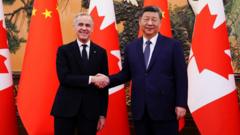
China and Canada announce tariffs relief after a high-stakes meeting between Carney and Xi
Politics

China and Canada announce tariffs relief after a high-stakes meeting between Carney and Xi

Canola oil and electric cars are at the centre of the deal agreed by Mark Carney and Xi Jinping after years of strained ties.

1d
3 min
0
Read Article
Google Tightens Crypto Rules in South Korea
Cryptocurrency

Google Tightens Crypto Rules in South Korea

Google's updated policy requires proof of FIU registration for crypto apps, raising significant compliance hurdles for offshore exchanges targeting South Korean users.

1d
5 min
6
Read Article
El príncipe Enrique volverá al Reino Unido para testificar en el caso contra el ‘Daily Mail’ por violación de su intimidad
Society

El príncipe Enrique volverá al Reino Unido para testificar en el caso contra el ‘Daily Mail’ por violación de su intimidad

El duque de Sussex y otros seis demandantes, incluido Elton John, comparecerán el 22 de enero en el juicio que, previsiblemente, pondrá fin a su batalla judicial contra la prensa británica por recabar información con supuestas prácticas ilegales

1d
3 min
0
Read Article
EU-Mercosur Deal: Environmental Concerns Rise
Politics

EU-Mercosur Deal: Environmental Concerns Rise

As the European Union prepares to sign a historic trade agreement with South America's Mercosur bloc, critics warn that environmental concerns are being sidelined in the face of intense geopolitical competition.

1d
5 min
6
Read Article
EO Media Expands Content Slate with 20 New Titles
Entertainment

EO Media Expands Content Slate with 20 New Titles

Ezequiel Olzanski has expanded EO Media's Content Americas 2026 sales slate with 20 new titles, drawing on strategic alliances with U.S.-based Nicely Entertainment and Miami's Gluon Media.

1d
4 min
6
Read Article
AI Cybersecurity Divide: CEOs Split on Risks
Technology

AI Cybersecurity Divide: CEOs Split on Risks

A new survey reveals a growing divide among C-suite executives on the cybersecurity risks and rewards of artificial intelligence, highlighting divergent perspectives at the highest levels of corporate leadership.

1d
5 min
6
Read Article
🎉

You're all caught up!

Check back later for more stories

Back to Home