M
MercyNews
Home
Back
Tunisian Activists Fight for Water Access Amid Shortages
World_news

Tunisian Activists Fight for Water Access Amid Shortages

France 24Jan 6
3 min read
📋

Key Facts

  • ✓ Tunisian communities are increasingly frustrated that access to drinking water is still not a given, particularly for rural communities
  • ✓ Hundreds of thousands of people are thought not to be connected to distribution networks at all
  • ✓ Some communities live next to the very dams that supply bigger cities

In This Article

  1. Quick Summary
  2. Rural Communities Face Critical Shortages
  3. Proximity to Dams Highlights Inequality
  4. Activists Mobilize for Change
  5. Broader Implications for Water Management

Quick Summary#

Tunisian communities are increasingly frustrated that access to drinking water is still not a given, particularly for rural communities. Hundreds of thousands of people are thought not to be connected to distribution networks at all. To make matters worse: some live next to the very dams that supply bigger cities.

Rural Communities Face Critical Shortages#

Access to drinking water remains a significant challenge across many parts of Tunisia, with rural areas bearing the brunt of the crisis. According to available estimates, hundreds of thousands of Tunisians lack connection to formal water distribution networks entirely. This leaves many residents dependent on unreliable or unsafe water sources.

The disparity is particularly stark when comparing urban and rural infrastructure. While cities generally maintain more consistent supply lines, remote villages often find themselves at the end of a very long queue for resource allocation.

Key challenges facing these communities include:

  • Lack of connection to municipal distribution systems
  • Reliance on intermittent or unregulated water sources
  • Proximity to water infrastructure that bypasses them

Proximity to Dams Highlights Inequality#

The irony of the situation is most visible in communities situated directly next to major dams. These reservoirs are critical infrastructure designed to supply larger urban centers, yet the adjacent populations often see little benefit from their presence.

Residents living near these facilities report a sense of injustice, watching vast quantities of water being pumped away to distant cities while their own taps run dry. This geographical juxtaposition serves as a physical manifestation of the country's resource distribution disparities.

Local activists point out that these communities should theoretically be the first to benefit from nearby infrastructure, yet they remain among the most underserved populations in the country.

Activists Mobilize for Change#

In response to these growing inequities, Tunisian activists are stepping up efforts to fight for community water rights. Their focus is on ensuring that access to water is treated as a fundamental right rather than a privilege reserved for urban centers.

The movement seeks to:

  1. Highlight the plight of unconnected rural populations
  2. Pressure authorities to prioritize infrastructure expansion
  3. Ensure fair distribution of resources from existing dams

These efforts come at a critical time when water scarcity issues are becoming more acute across the region, making the need for equitable solutions more urgent than ever.

Broader Implications for Water Management#

The situation in Tunisia reflects broader challenges in water resource management that many nations face. Balancing the needs of urban populations with rural development remains a complex policy challenge.

Infrastructure investment typically favors areas with higher population density, but this approach often leaves peripheral communities behind. The current crisis suggests that a reevaluation of water distribution priorities may be necessary to address these systemic gaps.

As climate patterns shift and populations grow, the pressure on existing water systems will likely intensify, making resolution of these disparities increasingly important for national stability and public health.

Continue scrolling for more

AI Transforms Mathematical Research and Proofs
Technology

AI Transforms Mathematical Research and Proofs

Artificial intelligence is shifting from a promise to a reality in mathematics. Machine learning models are now generating original theorems, forcing a reevaluation of research and teaching methods.

Just now
4 min
175
Read Article
Politics

Iran set to execute protester days after arrest as Tehran speeds up death sentences

Erfan Soltani, 26, was detained at his home in Fardis on 8 January. Four days later, authorities notified his family a death sentence had been issued and confirmed.

18m
3 min
0
Read Article
How business leaders are responding to Trump's plan to cap credit card interest rates, from JPMorgan to SoFi
Politics

How business leaders are responding to Trump's plan to cap credit card interest rates, from JPMorgan to SoFi

Business leaders like Klarna's CEO support Trump's credit card cap proposal, while major banks and investors warn of risks. BRENDAN SMIALOWSKI/AFP via Getty Images Donald Trump proposes a 10% cap on credit card interest rates starting January 20, 2026. Business leaders like Klarna's CEO support the cap, while major banks and investors warn of risks. The proposal sparks debate on consumer protection, credit access, and industry profitability. Business leaders have mixed reviews of President Donald Trump's new plan for credit cards. In a post on Truth Social, Trump said on Friday he would call for a one-year cap of 10% on credit card interest rates, arguing that consumers are being "ripped off" by rates that he said can be as high as 20% or 30%. Congress, not the president, has the power to implement such a cap. Similar proposals have previously stalled on Capitol Hill. Major banks, including JPMorgan Chase, UBS, and Citi, warned that a 10% cap could reduce access to credit; others in the financial sector applauded the plan. Here is how business leaders have responded so far Sebastian Siemiatkowski Sebastian Siemiatkowski, CEO and cofounder of Klarna, at the fintech company's IPO on September 10. Bloomberg / Contributor / Getty Images/Reuters Klarna CEO Sebastian Siemiatkowski backs Trump's plan. Siemiatkowski told CNBC in an interview on Monday that traditional credit cards are built to encourage consumers to put most of their spending on credit, and then carry big balances at steep interest rates. That dynamic, he said, pushes people to borrow more than they should and results in higher losses, especially among lower-income borrowers. "I think Trump is wise here and is proposing something that makes a lot of sense," Siemiatkowski told CNBC on Monday. "Capitalism is great, but anarchy is not," Siemiatkowski added regarding consumer protection. In another interview with CNN, Siemiatkowski also said that credit card rewards like cash back and airline miles largely benefit wealthier consumers while lower-income cardholders shoulder more of the costs. Jeremy Barnum JPMorgan Chase CFO Jeremy Barnum speaks at the bank's 2025 Investor Day presentation in New York City on May 19. JPMorgan 2025 Investor Day JPMorgan's CFO said that Trump's plan could upend the company's business model. "It's a very competitive business, but we wouldn't be in it if it weren't a good business for us," said Jeremy Barnum during the company's fourth-quarter earnings call. "And in a world where price controls make it no longer a good business, that would present a significant challenge." JPMorgan said on its fourth-quarter earnings call that debit and credit card sales volume rose roughly 7% year over year and described the business as central to its retail-focused offerings. Jamie Dimon JPMorgan CEO Jamie Dimon. Alexander Tamargo/Getty Images for America Business Forum The CEO of JPMorgan also weighed in on Trump's credit card proposal. Jamie Dimon told investors on the company's fourth-quarter earnings call that reducing card interest rates could adversely affect customers with lower credit scores by limiting access to credit. "If it happened the way it was described, it would be dramatic," Dimon said. Bill Ackman PATRICK T. FALLON/AFP via Getty Images "This is a mistake, President," Bill Ackman, the billionaire CEO of Pershing Square Capital Management, wrote on Friday on X in a now-deleted post. "Without being able to charge rates adequate enough to cover losses and to earn an adequate return on equity, credit card lenders will cancel cards for millions of consumers who will have to turn to loan sharks for credit at rates higher than and on terms inferior to what they previously paid," Ackman added. Ackman said in another post on Saturday that although Trump's goal is one that's "worthy and important," the rate cap is not the way to achieve it. "The best way to bring down rates would be to make it more competitive by making the regulatory regime more conducive to new entrants and new technologies," Ackman wrote. Anthony Noto Mike Ehrmann/TGL/TGL Golf via Getty Images The SoFi CEO believes that his business and consumers could stand to benefit from Trump's credit card rate cap. "If this is enacted — and that's a big if, though part of me hopes it is — we would likely see a significant contraction in industry credit card lending," Anthony Noto wrote in a post on X. "Credit card issuers simply won't be able to sustain profitability at a 10% rate cap." "Consumers, however, will still need access to credit. That creates a large void — one that @SoFi personal loans are well positioned to fill," Noto added. Noto also said that personal loans could be an alternative to addressing debt, though that would make underwriting discipline and borrower education "even more important." Read the original article on Business Insider

20m
3 min
0
Read Article
Putin's Ukraine Focus Exposes Global Allies
Politics

Putin's Ukraine Focus Exposes Global Allies

A year into the Ukraine conflict, Moscow's authoritarian partners are discovering their security ties to Russia may be little more than a paper tiger, with support failing to materialize when most needed.

32m
5 min
7
Read Article
Animoca Acquires Somo as NFT Market Rebounds
Technology

Animoca Acquires Somo as NFT Market Rebounds

In a significant move for the digital assets landscape, Animoca Brands has acquired Somo, signaling renewed confidence in the NFT market as trading activity shows early signs of recovery.

35m
5 min
1
Read Article
China's much-hyped radars appear to have been of little help when the US launched its massive air assault against Venezuela
World_news

China's much-hyped radars appear to have been of little help when the US launched its massive air assault against Venezuela

China's JY-27A radar didn't appear to be effective during the US raid on Venezuela. US Air Force Photo Venezuela's Chinese air defense radars weren't game-changing during the US raid to capture Maduro. China has touted the effectiveness in combat of radars like its JY-27A. The lack of effect recently raises questions about both the radar and their operators. Venezuela's military had Chinese-made anti-aircraft radars available when the US launched a surprise air assault against the country to capture the country's now-former leader, Nicolás Maduro, earlier this month. They appear to have been of little help. Operation Absolute Resolve involved over 150 US military aircraft, none of which were shot down. A helicopter was hit, reportedly by machine gun fire, but remained operational. Venezuela has a number of China's JY-27A mobile radars, which Beijing has touted as top-of-the-line systems. It has said the radar can detect stealth assets, like the American F-22 and F-35, from over 150 miles away. The success of the surprise raid by US special operators into downtown Caracas, part of a larger mission which involved not only stealth airpower but also older fourth-generation aircraft and helicopters, suggests that something didn't go as planned on defense. That may be on the operators rather than the tech though. After the raid, a Japanese reporter asked a Chinese foreign ministry spokesperson what Beijing thought about the "large amount of military equipment" China sold Venezuela apparently being "of little practical use." The Chinese spokesperson responded by condemning the US strike. A destroyed air defense unit at a Venezuelan military base. Leonardo Fernandez Viloria/REUTERS The Chinese-made JY-27A is a long-range radar used for detecting and tracking hostile aircraft in protected airpsace. Introduced in 2014, the radar system consists of a radar mast with multiple antenna panels supported by separate radar and control vehicles. Chinese sources claim it has features designed to reduce jamming. A newer version, the JY-27V, has since been developed. When Venezuela purchased JY-27As from China last year, there were claims that the radars were able to lock onto multiple F-35B fighter jets off the Venezuelan coast, presenting a potential challenge to the one-way transparency advantage of the US military. "That's all well and good," Michael Sobolik, a senior fellow at the Hudson Institute, told Business Insider, "but when it really matters is in a moment of conflict." Perhaps they were unable to withstand sophisticated electromagnetic spectrum attacks, or maybe they were improperly utilized by their operators. Either way, if they weren't effective, they were of little use for air defense. Radar systems are what inform air defense crews on what they'll need to target and what weapons they need to use. "If you don't have functioning radars then you're a sitting duck," he said. US military leaders said that American aircraft were able to overwhelm Venezuelan air defenses, which has been assessed to include a range of Russian-made systems like S-300VM batteries, Buk-M2 systems, and older S-125 Pechora-2M launchers, as well as the Chinese radars. Some of these pieces are capable but aren't the newest variants used by their respective exporters. In the aftermath, Secretary of Defense Pete Hegseth mocked the effectiveness of the Russian air defenses. Nothing was said about the Chinese radars in that speech. Key to air defense is how the network works together, and the effectiveness of the operator is vital. In Venezuela's case, it may have been lacking the necessary conditions for successful air defense operations. Seven US troops were hurt during the raid in Venezuela over the weekend, a defense official said. US Air Force photo by Airman 1st Class Isabel Tanner A study from the Miami Strategic Intelligence Institute think tank, which hosts experts on Latin America, assessed Venezuela's air defenses as being in critical condition as of last year. It said that over 60% of its radar fleet was non-operational, combat aviation doesn't fly often, and the country has received little maintenance support and spare parts from its exporters. Venezuela purchased Chinese-made radars and Russian-made surface-to-air missile batteries to modernize its air defenses, but the hardware alone can't make up for internal shortcomings. Analysis by The New York Times found that some of Venezuela's air defense equipment was in storage or not operational, leaving it unprepared for the US attack. Reports also indicated Venezuela's military lacked the spare parts and technical background to keep air defense systems running. Even if the failures are on the part of the Venezuelan military, the ineffective performance of the Russian and Chinese systems sends a "pretty big message," Sobolik said. It elevates confidence in US capabilities while raising questions about those of rivals. US officials said no American aircraft or military personnel were lost during the raid on Venezuela. Of the 150 aircraft and almost 200 American troops involved in the mission, one helicopter took fire and seven troops were injured. Read the original article on Business Insider

38m
3 min
0
Read Article
AI Resistance? The 4-Day Workweek Solution
Technology

AI Resistance? The 4-Day Workweek Solution

As companies invest millions in AI, many workers resist the technology. Authors of a new book argue that sharing efficiency gains through a shorter workweek could be the key to adoption.

41m
5 min
5
Read Article
François de Rugy Endorses Right-Wing Candidate in Nantes
Politics

François de Rugy Endorses Right-Wing Candidate in Nantes

In a significant political realignment, François de Rugy, a former prominent figure on the French left, has announced his support for the right-wing candidate Foulques Chombart de Lauwe in the upcoming Nantes municipal elections.

44m
5 min
6
Read Article
Japan's Takaichi Calls Snap Election
Politics

Japan's Takaichi Calls Snap Election

Prime Minister Takaichi has announced plans for a snap election in Japan, a strategic move designed to strengthen the ruling party's position and solidify the new leader's mandate.

45m
3 min
7
Read Article
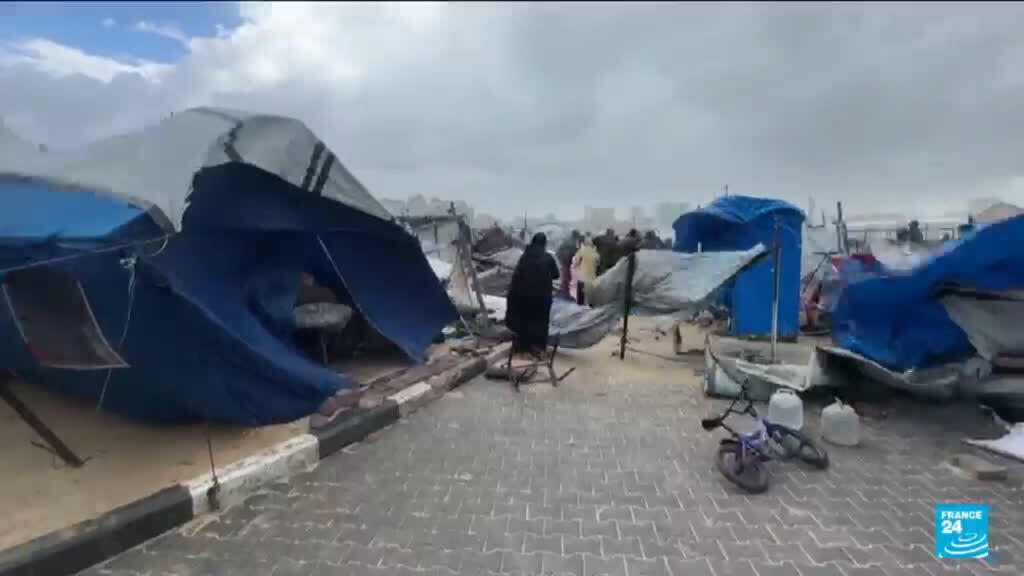
Gaza: Hypothermia kills 5 as blockade hinders aid
World_news

Gaza: Hypothermia kills 5 as blockade hinders aid

Despite the ceasefire, conditions in Gaza remain perilous for many residents, with UNICEF reporting that more than 100 children have been killed by military action since the truce began. Large numbers of people are living in makeshift tent camps that offer little protection from harsh weather, while many buildings remain structurally unsafe following Israeli bombardments. On Tuesday, at least four people were killed when a wall collapsed onto their tent in Gaza. Ellen Gainsford reports.

55m
3 min
0
Read Article
🎉

You're all caught up!

Check back later for more stories

Back to Home