M
MercyNews
Home
Back
Macron Accuses US of Abandoning Allies
Politics

Macron Accuses US of Abandoning Allies

Euronews5d ago
3 min read
📋

Key Facts

  • ✓ French President Emmanuel Macron accused the US of 'gradually turning away' from allies.
  • ✓ The accusation was made during a speech to French ambassadors.
  • ✓ US President Donald Trump claimed he coerced France into tripling its drug prices.

In This Article

  1. Quick Summary
  2. Macron's Diplomatic Warning
  3. Trump's Comments on Drug Prices
  4. Implications for US-France Relations
  5. Future of the Alliance

Quick Summary#

French President Emmanuel Macron has accused the United States of 'gradually turning away' from its allies in a significant speech to French ambassadors. The remarks highlight growing friction between Paris and Washington under the current US administration. This diplomatic rift was recently intensified by comments from US President Donald Trump, who claimed he coerced France into tripling its drug prices.

Macron's Diplomatic Warning#

French President Emmanuel Macron addressed the gathered French diplomatic corps in Paris, delivering a stark assessment of the current geopolitical landscape. In his remarks, Macron explicitly accused the United States of 'gradually turning away' from its long-standing allies. This statement serves as a public acknowledgment of the strain currently affecting the transatlantic alliance.

The French leader's comments reflect a growing concern within European capitals regarding the consistency and commitment of the United States to mutual defense and economic agreements. Macron's rhetoric suggests a need for Europe to reassess its strategic autonomy and reliance on American support. The speech was intended to outline France's foreign policy priorities for the coming year, but it was dominated by the shifting dynamics with Washington.

"gradually turning away"

— Emmanuel Macron, President of France

Trump's Comments on Drug Prices#

The diplomatic tension was further exacerbated by recent remarks made by US President Donald Trump during an address on Wednesday. Trump took a 'potshot' at the French leader, recounting a specific instance of economic pressure applied to France. According to Trump's account, he successfully coerced France into agreeing to triple its drug prices.

This specific accusation adds a tangible economic dimension to the abstract diplomatic grievances. The implication that the US administration used strong-arm tactics to force policy changes in France supports Macron's assertion that the US is moving away from a cooperative alliance model. The incident underscores the personal and political friction between the two heads of state, complicating traditional state-to-state relations.

Implications for US-France Relations#

The combination of Macron's broad accusation and Trump's specific recounting of coercion paints a picture of a fractured relationship. Historically, the United States and France have been key partners in NATO and the G7. However, the current rhetoric suggests a breakdown in the diplomatic norms that usually govern such alliances.

Observers note that public disputes between leaders of this magnitude are rare and indicate deeper systemic issues. The reference to drug pricing suggests that trade and health policy have become battlegrounds in this diplomatic struggle. As France prepares its diplomatic strategy, these events may lead to a pivot toward other regional partners or a renewed push for European independence from US influence.

Future of the Alliance#

The future of the transatlantic alliance appears uncertain following these events. Macron's speech serves as a warning that the status quo is no longer acceptable to France. The 'gradual turning away' described by the President implies a slow but steady erosion of trust that may be difficult to repair.

Whether this rhetoric translates into concrete policy changes remains to be seen. However, the public nature of these accusations ensures that the issue will remain a focal point of international news. The relationship between Paris and Washington will likely be scrutinized closely in the coming months as both nations navigate this period of heightened tension.

"coerced France into agreeing to triple its drug prices"

— Donald Trump, President of the United States

Continue scrolling for more

AI Transforms Mathematical Research and Proofs
Technology

AI Transforms Mathematical Research and Proofs

Artificial intelligence is shifting from a promise to a reality in mathematics. Machine learning models are now generating original theorems, forcing a reevaluation of research and teaching methods.

Just now
4 min
175
Read Article
Putin's Ukraine Focus Exposes Global Allies
Politics

Putin's Ukraine Focus Exposes Global Allies

A year into the Ukraine conflict, Moscow's authoritarian partners are discovering their security ties to Russia may be little more than a paper tiger, with support failing to materialize when most needed.

25m
5 min
6
Read Article
Animoca buys Somo as NFT market rebounds early in 2026
Technology

Animoca buys Somo as NFT market rebounds early in 2026

Animoca’s Somo acquisition expands its digital collectibles strategy as NFTs show early signs of renewed trading activity.

29m
3 min
0
Read Article
Canada's Premier Courts China Amid US Trade Tensions
Politics

Canada's Premier Courts China Amid US Trade Tensions

Prime Minister Mark Carney's inaugural visit to Beijing marks a potential turning point in Canada-China relations, as Ottawa seeks new economic partnerships while managing complex ties with Washington.

29m
5 min
6
Read Article
China's much-hyped radars appear to have been of little help when the US launched its massive air assault against Venezuela
World_news

China's much-hyped radars appear to have been of little help when the US launched its massive air assault against Venezuela

China's JY-27A radar didn't appear to be effective during the US raid on Venezuela. US Air Force Photo Venezuela's Chinese air defense radars weren't game-changing during the US raid to capture Maduro. China has touted the effectiveness in combat of radars like its JY-27A. The lack of effect recently raises questions about both the radar and their operators. Venezuela's military had Chinese-made anti-aircraft radars available when the US launched a surprise air assault against the country to capture the country's now-former leader, Nicolás Maduro, earlier this month. They appear to have been of little help. Operation Absolute Resolve involved over 150 US military aircraft, none of which were shot down. A helicopter was hit, reportedly by machine gun fire, but remained operational. Venezuela has a number of China's JY-27A mobile radars, which Beijing has touted as top-of-the-line systems. It has said the radar can detect stealth assets, like the American F-22 and F-35, from over 150 miles away. The success of the surprise raid by US special operators into downtown Caracas, part of a larger mission which involved not only stealth airpower but also older fourth-generation aircraft and helicopters, suggests that something didn't go as planned on defense. That may be on the operators rather than the tech though. After the raid, a Japanese reporter asked a Chinese foreign ministry spokesperson what Beijing thought about the "large amount of military equipment" China sold Venezuela apparently being "of little practical use." The Chinese spokesperson responded by condemning the US strike. A destroyed air defense unit at a Venezuelan military base. Leonardo Fernandez Viloria/REUTERS The Chinese-made JY-27A is a long-range radar used for detecting and tracking hostile aircraft in protected airpsace. Introduced in 2014, the radar system consists of a radar mast with multiple antenna panels supported by separate radar and control vehicles. Chinese sources claim it has features designed to reduce jamming. A newer version, the JY-27V, has since been developed. When Venezuela purchased JY-27As from China last year, there were claims that the radars were able to lock onto multiple F-35B fighter jets off the Venezuelan coast, presenting a potential challenge to the one-way transparency advantage of the US military. "That's all well and good," Michael Sobolik, a senior fellow at the Hudson Institute, told Business Insider, "but when it really matters is in a moment of conflict." Perhaps they were unable to withstand sophisticated electromagnetic spectrum attacks, or maybe they were improperly utilized by their operators. Either way, if they weren't effective, they were of little use for air defense. Radar systems are what inform air defense crews on what they'll need to target and what weapons they need to use. "If you don't have functioning radars then you're a sitting duck," he said. US military leaders said that American aircraft were able to overwhelm Venezuelan air defenses, which has been assessed to include a range of Russian-made systems like S-300VM batteries, Buk-M2 systems, and older S-125 Pechora-2M launchers, as well as the Chinese radars. Some of these pieces are capable but aren't the newest variants used by their respective exporters. In the aftermath, Secretary of Defense Pete Hegseth mocked the effectiveness of the Russian air defenses. Nothing was said about the Chinese radars in that speech. Key to air defense is how the network works together, and the effectiveness of the operator is vital. In Venezuela's case, it may have been lacking the necessary conditions for successful air defense operations. Seven US troops were hurt during the raid in Venezuela over the weekend, a defense official said. US Air Force photo by Airman 1st Class Isabel Tanner A study from the Miami Strategic Intelligence Institute think tank, which hosts experts on Latin America, assessed Venezuela's air defenses as being in critical condition as of last year. It said that over 60% of its radar fleet was non-operational, combat aviation doesn't fly often, and the country has received little maintenance support and spare parts from its exporters. Venezuela purchased Chinese-made radars and Russian-made surface-to-air missile batteries to modernize its air defenses, but the hardware alone can't make up for internal shortcomings. Analysis by The New York Times found that some of Venezuela's air defense equipment was in storage or not operational, leaving it unprepared for the US attack. Reports also indicated Venezuela's military lacked the spare parts and technical background to keep air defense systems running. Even if the failures are on the part of the Venezuelan military, the ineffective performance of the Russian and Chinese systems sends a "pretty big message," Sobolik said. It elevates confidence in US capabilities while raising questions about those of rivals. US officials said no American aircraft or military personnel were lost during the raid on Venezuela. Of the 150 aircraft and almost 200 American troops involved in the mission, one helicopter took fire and seven troops were injured. Read the original article on Business Insider

32m
3 min
0
Read Article
One thing that might get workers to embrace AI? The 4-day workweek.
Technology

One thing that might get workers to embrace AI? The 4-day workweek.

Working fewer days might help create buy-in among workers for adopting AI, authors of a book on the four-day workweek suggest. Drew Angerer/Getty Images Adopting a four-day workweek could boost employees' support for using AI on the job. CEOs report that some workers are resisting the technology, despite firms making big investments. Authors of a book on a four-day workweek say that the setup could let workers share in AI's gains. Bosses, if you're struggling to get your people excited about AI, here's one idea: Embrace the four-day workweek. Sharing some of AI's promised efficiency gains with employees — by letting them work fewer hours, not just get more done — could help get workers on board with a technology that some fear might ultimately replace them, authors of a new book advocating for a shorter workweek told Business Insider. Letting workers put in four days' work for five days' pay would be one way to "share the rewards" of innovation and technological advancement, said Jared Lindzon, a coauthor of the book "Do More in Four." When it comes to AI, giving workers more time away from their jobs could make it more likely they'd get behind the technology "because they're getting part of that benefit," rather than standing in the way of it, he said. Joe O'Connor, Lindzon's coauthor, said that when it comes to discussions about AI in the workplace, the conversation among workers often turns to fears of job cuts. 'Cultural resistance and emotional friction' Anxiety about AI-induced layoffs might be one reason rolling out the technology has proven difficult for some companies. In an early 2025 survey of business leaders in eight countries from the IT company Kyndryl, 45% of CEOs said their workers were resisting the technology. "Cultural resistance and emotional friction" are the biggest impediments to AI adoption, Boston Consulting Group reported in 2025. That's unwelcome news for C-suite decision-makers eager to ratchet up efficiency. One in three companies is pumping at least $25 million into AI, according to BCG. Business leaders have, at times, publicly expressed their frustration over some workers' foot-dragging. Coinbase CEO Brian Armstrong said in 2025 that he'd gone "rogue" in firing some workers at the crypto exchange who didn't adopt AI after being told to do so. The head of the software company IgniteTech has, meanwhile, lamented that "changing minds was harder than adding skills." In recent years, the firm cut nearly eight in 10 workers after they failed to quickly embrace AI. Nurturing the productivity gains that many leaders seek will often require people to perform different kinds of work — especially as AI takes over some tasks, O'Connor said. He expects that demand for creativity, judgment, critical thinking, and adaptability will increase and that those "fundamentally human" traits won't be fostered by simply moving faster or working longer, he said. "It's going to be more about maximizing people's energy, maximizing people's motivation, maximizing people's well-being and recovery," O'Connor said. A four-day workweek could promote those things, he said. Some leaders expect workweeks will shrink The idea that AI could allow people to work less isn't new. For years, the technology's advocates have said it could free up humans to do more of what they love, while handing off the grunt work to bots. The CEO of startup Mechanize, for example, says the company's aim is to automate every job. That notion has led some of the biggest corporate luminaries to predict that working hours could plummet as AI adoption increases. Microsoft cofounder Bill Gates has said that time on the clock might shrink to two days, while JPMorgan's Jamie Dimon has said workweeks of 3.5 days could become a thing. Even Nvidia's Jensen Huang — known for regularly putting in 14-hour days at the chipmaker and working on holidays — has said he could see the tech allowing for more time away from the office. Politicians have weighed in, too. Vermont Senator Bernie Sanders, citing efficiency gains from technology such as AI, introduced legislation in 2024 to trim the standard workweek to 32 hours. There hasn't yet been widespread adoption of the four-day workweek, likely in part because employers wield more power in many parts of the job market. O'Connor said that while adoption of four-day setups was lower in 2025 than in 2023, when far more workers were job-hopping, more employers are opting for shorter weeks than before the pandemic upended norms about work. Not all CEOs will be ready to give up the gains Umesh Ramakrishnan, cofounder of the executive search and leadership advisory firm Kingsley Gate, told Business Insider that many leaders, himself included, would want to harness AI's productivity gains to boost a business's top and bottom lines. "If you have a day to spare, get me more revenue, get me more profit," he said, adding that while it might sound "heartless," that's simply how business works. Yet, Lindzon said, asking workers to be 20% more effective — the equivalent of a single day in a standard workweek — so that they might benefit from that boost is likely to be more effective than asking them to do it for the good of the company. "It completely changes the conversation from a 'You have to do this' to 'We get to do this together,'" he said. Do you have a story to share about your career? Contact this reporter at tparadis@businessinsider.com. Read the original article on Business Insider

35m
3 min
0
Read Article
François de Rugy Endorses Right-Wing Candidate in Nantes
Politics

François de Rugy Endorses Right-Wing Candidate in Nantes

In a significant political realignment, François de Rugy, a former prominent figure on the French left, has announced his support for the right-wing candidate Foulques Chombart de Lauwe in the upcoming Nantes municipal elections.

37m
5 min
6
Read Article
Japan's Takaichi Calls Snap Election
Politics

Japan's Takaichi Calls Snap Election

Prime Minister Takaichi has announced plans for a snap election in Japan, a strategic move designed to strengthen the ruling party's position and solidify the new leader's mandate.

39m
3 min
6
Read Article
Galaxy warns Senate crypto bill gives US Treasury massive surveillance power
Politics

Galaxy warns Senate crypto bill gives US Treasury massive surveillance power

Galaxy says the draft crypto market structure bill would give the US Treasury new powers to freeze transactions and deploy Patriot Act–style measures.

40m
3 min
0
Read Article
Gaza: Hypothermia kills 5 as blockade hinders aid
World_news

Gaza: Hypothermia kills 5 as blockade hinders aid

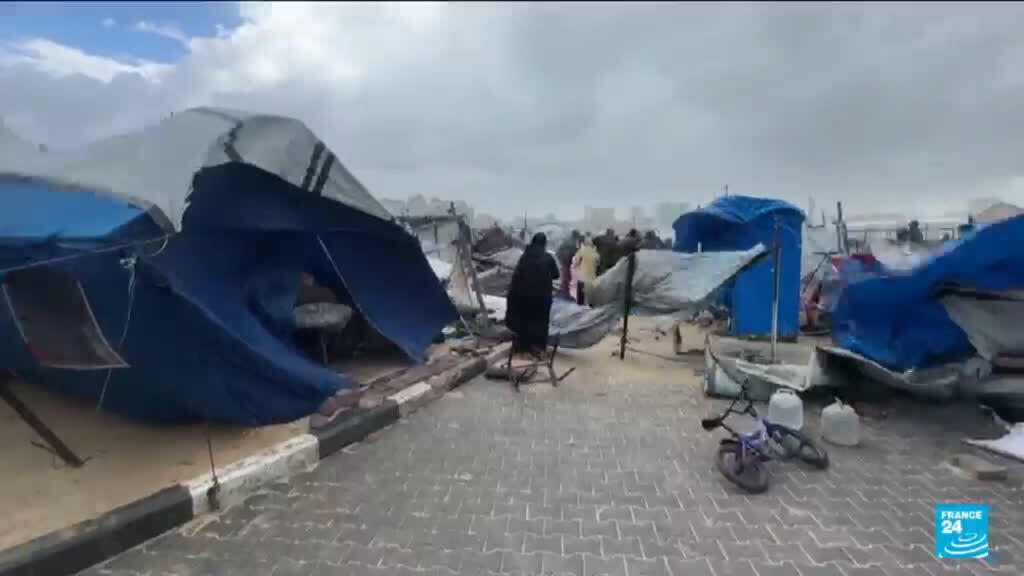
Despite the ceasefire, conditions in Gaza remain perilous for many residents, with UNICEF reporting that more than 100 children have been killed by military action since the truce began. Large numbers of people are living in makeshift tent camps that offer little protection from harsh weather, while many buildings remain structurally unsafe following Israeli bombardments. On Tuesday, at least four people were killed when a wall collapsed onto their tent in Gaza. Ellen Gainsford reports.

48m
3 min
0
Read Article
🎉

You're all caught up!

Check back later for more stories

Back to Home